
10 Critical Prompt Engineering Mistakes Killing Your AI Results (How to fix)
Prompt Engineering is not magic. It is a skill. I learned that the hard way.
When I first started using AI tools, I thought better tools meant better answers. I was wrong. By continuously improving and iterating my prompts i realized the output depends on what details we feed to the system.
In this guide, I will show you 10 critical mistakes I made earlier in my Prompt Engineering journey. More importantly, I will show you how I fixed them.
Why Prompt Engineering Matters More Than You Think
Prompt Engineering controls the direction of AI output. If your input is vague, your output will be vague too.
I noticed that even powerful models struggle with unclear instructions. AI follows patterns. It does not guess your intention.
According to HubSpot, AI works best when guided with structured inputs. That means your prompts must be clear, contextual, and specific. For understanding the Prompt writing checklist you can read my article on “How to write effective prompts” here
Let us break down the 10 most common mistakes you make as a beginner.
1. Writing Vague Prompts in Prompt Engineering
This was my biggest mistake.
I used to write prompts like, “Write about marketing.” The output was generic. Nothing stood out.
Prompt Engineering demands precision. Instead, I learned to write: “Write a 500-word beginner guide on email marketing for small businesses in the US.”
Specific prompts produce focused answers. Always define topic, audience, format, and length.
2. Ignoring Context in Prompt Engineering
Think of context as the high-octane fuel for AI. Without it, you’re essentially asking a world-class navigator to drive you somewhere without giving them the destination.
In the past, many users expected these models to simply “know” or remember their specific needs intuitively. When the AI missed the mark, it was usually because the user forgot to provide the necessary background details.
Compare a “cold” prompt to a “context-rich” prompt:
- Weak Prompt: “Write a workout plan.”
- Strong Prompt: “Act as a certified personal trainer writing for busy corporate employees who spend 8 hours a day at a desk. Use an encouraging tone to help them find 15-minute exercise windows.”
By providing these guardrails, the AI no longer has to guess your intent—it can focus entirely on delivering a high-quality, tailored response.
3. Giving Too Many Instructions at Once
It is a common pitfall to assume that because AI is powerful, it can juggle an infinite number of variables at once. I once experimented with a 200-word prompt containing ten distinct tasks; the result, predictably, was a disorganized mess.
While modern AI models are capable of processing complex instructions, clarity remains the cornerstone of effective prompting. When too many objectives compete for the model’s attention, the quality of the output inevitably suffers.
To achieve academic excellence in your AI interactions, adopt a modular approach. Break your large-scale projects into a logical sequence:
Refine the Work: Polish the language and ensure it meets your rubric
Draft an Outline: Establish the skeletal structure first.
Expand the Content: Flesh out the details section by section.
4. Forgetting to Define Output Format in Prompt Engineering
You may have noticed that without specific guidance, AI outputs can vary wildly. One day you might receive a dense wall of text, and the next, a simple list of bullet points. This lack of consistency usually happens because the initial instructions failed to define the “deliverable” clearly.
To ensure your work meets the specific requirements of an assignment, you must be explicit with your formatting cues. For example, instead of a general request, try using directives like:
“Organize the essay using H2 and H3 headings.”
“Provide the data in a table format.”
When you specify the structure, the results are dramatic. Always remember: the more you define the frame, the better the AI paints the picture.
5. Not Assigning a Role to the AI
One of the most effective ways to elevate your work with AI is by assigning a specific persona to the model before it begins a task.
You might find that a general question like “Explain budgeting” yields a generic, dry response. However, the results improve instantly when you provide a clear point of view. For your next assignment, try framing your request with a specific role:
“You are a finance professor explaining personal budgeting to college freshmen.”
By utilizing role-based prompt engineering, you are giving the AI a “voice” and a clear direction. This technique allows you to control the tone—whether you need it to be academic, professional, or conversational—and ensures the level of detail is appropriate for the intended audience.
6. Overlooking Examples in Prompt Engineering
In our writing lab with my team, we often discuss how Prompt Engineering reaches its full potential when we provide clear models for the AI to follow.
It is a common mistake to expect a tool to mirror your unique voice or a specific academic style without first providing a reference. This is why “one-size-fits-all” prompts often miss the mark. To bridge this gap, you should incorporate sample sentences or a model paragraph into your instructions and direct the AI to emulate that specific tone and structure.
In technical terms, this is known as Few-Shot Prompting. It is a gold-standard industry practice, even highlighted in Google’s own developer documentation, as a way to achieve high-quality, structured output.
You can explore Google’s AI best practices here: Google AI Responsibility.
7. Skipping Iteration and Refinement
When I first started working with these tools, I made the common mistake of expecting a perfect response on my very first attempt.
In reality, Prompt Engineering is an iterative process. Your initial instructions are just the beginning. I found that my results only truly improved when I committed to refining my prompts step-by-step. This meant:
Simplifying Instructions: Breaking down complex goals into manageable parts.
Adjusting for Clarity: Making sure my “ask” was unmistakable.
Removing Ambiguity: Cutting out vague words that could be misinterpreted.
I want you to stop thinking of prompts as rigid commands and start thinking of them as academic conversations. When the AI doesn’t hit the mark the first time, don’t get discouraged.
Instead, treat it like a tutoring session—provide feedback, clarify your intent, and guide the system toward the A+ result you’re looking for.
8. Using Complex Language in Prompt Engineering
when it comes to Prompt Engineering, I found out the hard way that sophisticated language doesn’t always impress the AI. In fact, using overly complex wording often just muddies the waters and leads to a confused output.
What I’ve learned—and what I want to share with you—is that clarity beats complexity every single time. If your instructions are buried under SAT-level vocabulary or convoluted grammar, the AI might miss the core objective of your assignment.
To get the best results, try adopting these “plain English” strategies:
Prioritize Precision: Choose the simplest word that accurately describes your goal.
Use Direct Language: Avoid “flowery” prose in your instructions.
Keep Sentences Lean: Shorter, punchy sentences significantly improve response accuracy.
9. Ignoring Constraints and Boundaries
We often find that total freedom can lead to a lack of focus. I’ve learned that the same applies to AI: constraints actually sharpen your output. Early on, I struggled with responses that were way too long or shifted into an unexpected tone because I hadn’t set any boundaries.
Now, I make it a point to define the “rules of the road” before the AI starts writing. To ensure your work stays on track, try incorporating these specific boundaries:
Exclusions: Explicitly state what to leave out (e.g., “Avoid using technical jargon or slang”)
Word Limits: Be clear about length (e.g., “Keep the summary under 150 words”).
Tone & Audience: Specify who the piece is for (e.g., “Write for a 10th-grade level”).
10. Not Testing Prompts Across Scenarios
The reality is that Prompt Engineering requires active testing. To get the best results for your projects, you have to be willing to “field test” your prompts across different scenarios. If a prompt works for a history summary, it might need a complete overhaul to work for a lab report.
To achieve consistent success, focus on these habits:
Incremental Refinement: Remember that even a small change in a single sentence can lead to a massive improvement in the final product.
A/B Testing: Try two different versions of a prompt to see which yields the “honor roll” result.
Contextual Tweaking: Adjust your wording to match the specific subject matter.
My Practical Framework for Better Prompt Engineering
To help you understand the best prompt crafting techniques, I have provided a sample checklist below. I use this checklist to write my prompts. Obviously, I don’t always get a 100% accurate result on the first try, but iterating helps me get closer to my desired output every time.
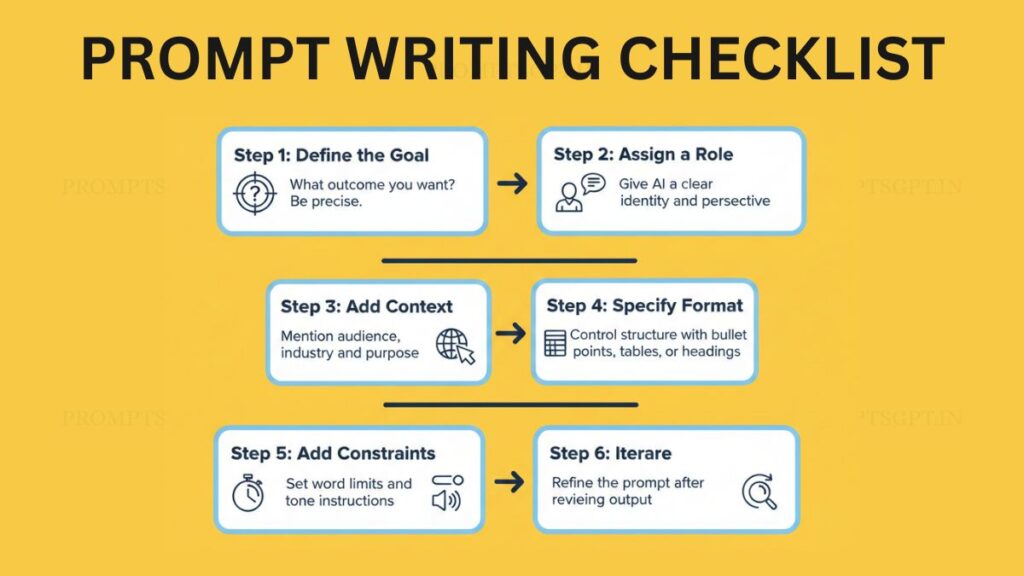
This simple structure improved my AI accuracy by a large margin. You can adopt it immediately.
Prompt Engineering Is a Skill You Build Daily
You will likely notice that as you make small, deliberate refinements to your instructions, your results will become increasingly predictable and professional.
A common pitfall in the learning process is to blame the AI for a subpar answer; however, in most academic and professional settings, the root of the issue is often found within the prompt itself.
Mastering these techniques provides a significant competitive advantage across various fields:
Content Creators: Can elevate the quality and consistency of their creative output.
Students: Can streamline the research process and organize study materials more effectively.
Working Professionals: Gain a serious edge by automating routine tasks with high-level precision.
Conclusion: Fix These Prompt Engineering Mistakes Today
I want you to remember one vital takeaway with the above Guide, your success with AI depends more on your Prompt Engineering than the specific model you’re using.
I’ve been exactly where you are—making these same mistakes and feeling the frustration. But once I corrected my approach, my productivity completely shifted. The best part? You don’t need a computer science degree to master this. What you truly need are clarity, structure, and a commitment to practice.
