
Context Engineering: Do Prompts Need Support Story in 2026?
Most people think AI gives bad answers because the prompt is “weak,” but the real problem is usually the CONTEXT. When you throw a one‑line prompt at ChatGPT, Gemini, or any other model without background, examples, or rules, you are asking it to guess what you really want.
Context engineering flips this around: you carefully feed the AI the right information before you ask for anything, so it understands your goal, your audience, and the data it must respect. In this tutorial, you will learn how to design powerful context, step by step, so your AI outputs become sharper, more accurate, and genuinely useful for real‑world application and beyond.

What Is Context Engineering?
Context engineering means designing and structuring all the information around a prompt so AI can answer well. It looks beyond a single line of text and treats AI as part of a larger system with goals, rules, and background knowledge.
In modern language models, context includes system instructions, user details, history, and attached documents. When this context is clear and relevant, hallucinations drop and answers match your domain and business needs better.
Why Context Beats Better Prompts
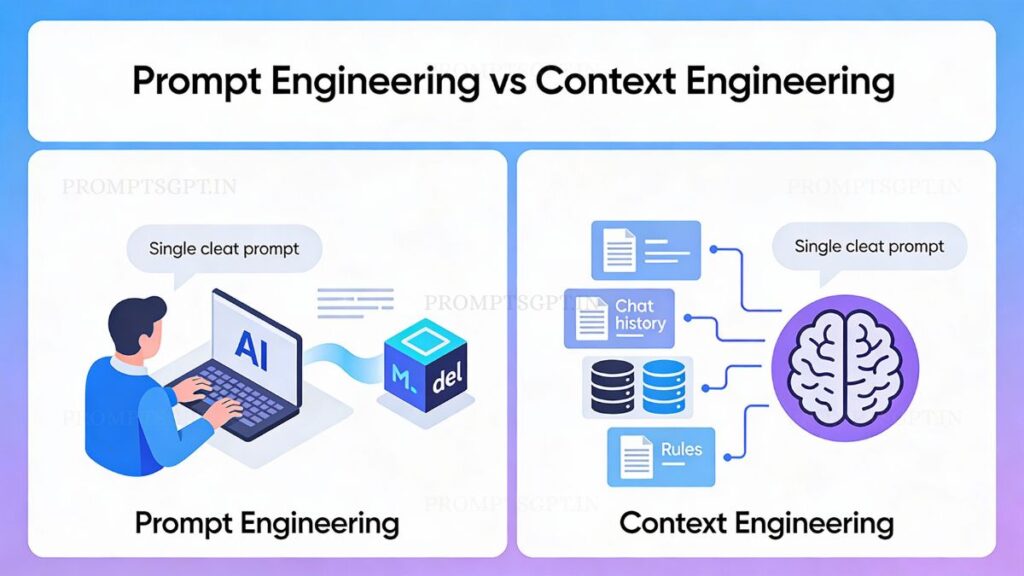
Prompt engineering focuses on how you phrase the request. That helps for simple tasks but often fails in real projects where the AI must follow policies, use private data, or stay consistent across many chats.
Context engineering fixes this by building an information “bubble” around the model. It adds roles, knowledge, memory, and rules that guide every output. With richer context, the model guesses less and follows your goals more closely.
Core Building Blocks of Good Context
To feed AI the right information, use a small checklist before each serious task.
- System role and objectives: Decide who the AI is and what success means. For example, “You are a senior SEO strategist for Indian blogs. Your goal is to create accurate, original content.”
- Domain knowledge and sources: Attach key docs, FAQs, policies, or URLs. These act as ground truth for the model instead of general web knowledge.
- User and task metadata: Tell the AI about your audience, tone, region, word count, and format. Mention tools or platforms if they matter, such as “WordPress blog for Indian creators.”
- Short‑term memory: Keep recent conversation turns so the model remembers decisions, definitions, and previous answers instead of repeating steps.
- Long‑term memory or profiles: For ongoing work, store notes on style, preferences, and important facts. Use these notes again in future sessions to keep outputs consistent.
Each part adds signal around your prompt. Together, they help the model reason more like a teammate who knows the project.
Step‑by‑Step Context Engineering Tutorial
Use this simple workflow whenever you set up an AI task.
- Define the outcome and constraints:
Start with a short brief. Write the goal, target audience, and a few success metrics. Add hard limits such as “Indian market”, “no legal advice”, or “1,500 words maximum”.
Turn this brief into system instructions. Tell the AI its role, main goal, and what to optimize for, such as accuracy, SEO, or clarity. - Curate the knowledge base:
Collect only the sources needed for this task. These could be old blog posts, product docs, policies, or research notes.
Put them in a form the AI can read. Paste short excerpts, upload files, or use a retrieval system that sends only relevant chunks to the model. - Assemble the input context window:
Combine the pieces in a clear order, such as “Role → Rules → Data → Task”. Start with system instructions, then add rules, then the key snippets, and finally the exact request.
Keep context tight. Remove details that do not support the task, because noisy text can confuse the model and waste tokens. - Guide reasoning and output format:
Add simple reasoning hints. Use phrases like “think step by step”, “list assumptions first”, or “explain your reasoning briefly”.
Define the output shape. Ask for headings, bullets, tables, or JSON so the result is ready to paste into your workflow or code. - Validate and refine the context loop:
After the model replies, check if it followed your sources and rules. If not, adjust the context rather than only tweaking the last sentence of the prompt.
Save good setups as “context profiles” for repeated tasks such as SEO posts, emails, or support answers. Reuse and improve these profiles over time.
Practical Examples: Feeding AI the Right Information
Imagine you want a long‑form article for Indian readers. A bare request like “Write a blog on context engineering” gives a generic piece with no local flavor or brand voice.
With context engineering, you first provide:
- Your brand tone and one or two sample posts.
- The target reader: Indian digital marketers, bloggers, or founders.
- Keyword goals, such as “context engineering tutorial” and “AI context for marketing in India”.
- A short, accurate definition of context engineering from trusted guides and your own notes.
Then you ask the AI to write the article. Because it sees the examples, audience, and goals, the draft is closer to what you would write yourself.
Support automation offers another clear example. Instead of assuming the model “knows” your product, you feed manuals, common questions, refund rules, and escalation steps as context. The same customer question then gets a policy‑correct, product‑aware answer rather than a guess.
Best Practices and Common Pitfalls
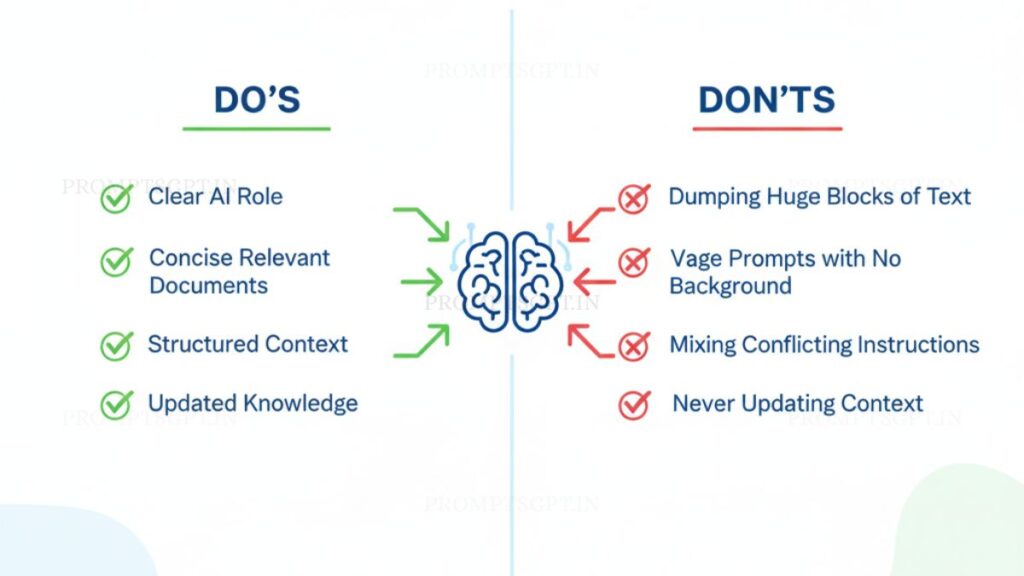
Good context engineering is about focus. Give the Ai model enough detail to understand the task but not so much that the key points get lost.
Follow these best practices:
- Always define a clear role and goal. A named role like “legal analyst” or “SEO editor” anchors the model’s behavior.
- Ground responses in your own or verified sources whenever the topic is specific, recent, or regulated.
- Refresh your context files regularly. Update guidelines, feature lists, and examples as your product or brand evolves.
Avoid these common mistakes:
- Using only a clever one‑line prompt with no background for complex tasks.
- Dumping long, unstructured documents into the context window without highlighting key sections.
- Keeping context static while your data, rules, or audience change over time.
How Context Engineering Fits Your Prompt Strategy
Prompt engineering still matters—it helps you ask clear questions and guide the model’s tone. But context engineering takes things further by supplying the background, constraints, and intent that allow AI to respond like a well-informed collaborator rather than a guessing engine.
As AI evolves toward agents, RAG-based systems, and multi-step workflows in 2025, context engineering is no longer optional. It is becoming a foundational skill for creators, marketers, and solo founders who want consistent, reliable, and high-quality AI outcomes. Those who master context won’t just get better answers—they’ll build systems that think, adapt, and deliver at scale.

Pingback: 7 Google Gemini Canvas Hacks, Transform Your Document Editing Now
Pingback: Google Prompt Engineering: Write Better AI Prompts in 2026
Pingback: How to go viral on Instagram with Nano Banana 2026 - Prompt Karo
Pingback: Reverse Prompting: A Master Tool for Better AI in 2026