

Google Prompt Engineering: Write Better AI Prompts in 2026
Imagine unlocking the hidden potential of artificial intelligence with just a few carefully chosen words. That’s what Google prompt engineering makes possible.
Google’s AI experts have distilled years of research into a simple truth: how you ask an AI question matters more than which AI you use. The right prompt can transform a mediocre response into exactly what you need.
This guide walks you through everything you need to know to write powerful, effective prompts using Google’s proven 5-step framework.
What Is Google Prompt Engineering?
Google prompt engineering is the art and science of crafting clear, specific instructions to guide generative AI tools toward producing exactly what you need.
Think of it like this: if AI is a powerful assistant, then prompt engineering is learning how to communicate with that assistant. Instead of vague requests, you learn to provide structured guidance. Instead of hoping for the best output, you design prompts that guarantee results.
Prompt engineering isn’t about coding or technical jargon. It’s about clear communication. Anyone can learn it, regardless of their technical background. You don’t need a computer science degree. You just need curiosity and willingness to experiment.
Why Google Prompt Engineering Matters Right Now
The demand for prompt engineering skills is exploding. According to LinkedIn, jobs in prompt engineering are growing faster than any other AI-related position worldwide.
Over 80% of companies in 2025 now use AI-powered tools daily. However, most employees use these tools poorly. They don’t understand how to communicate with AI. This creates a massive opportunity for anyone willing to learn.
Mastering Google prompt engineering positions you ahead of your peers. It boosts your productivity, opens new job opportunities, and enhances your creative problem-solving skills. In India specifically, skilled prompt engineers earn ₹8–40 LPA—significantly more than many other tech skills.

The 5-Step Google Prompt Engineering Framework Explained
Google’s Prompting Essentials course teaches a proven 5-step framework. This framework works across all AI tools, not just Google’s platforms.
Understanding the Task Step
Your task is the foundation of any effective prompt. Begin by clearly defining what you want the AI to accomplish.
For example, don’t say “Write something about climate change.” Instead, say “Write a 300-word summary of climate change’s impact on coastal cities for high school students.” Notice the difference? The second version includes specificity: length, topic angle, and audience level.
Adding Context: The Second Essential Element
Context bridges the gap between what you want and what the AI understands. It’s the background information that shapes the model’s thinking.
Google’s research shows that context-rich prompts produce 30% better results than generic ones. Therefore, include relevant details like audience expertise, desired tone, and any constraints.
Instead of “Explain AI to me,” try “Explain AI to me as if I’m a 10-year-old with no tech background, using only analogies from everyday life.” The second version provides crucial context.
Establishing Clear References and Examples
Few-shot prompting—providing examples of the desired output—dramatically improves results.
If you want the AI to write product descriptions, show it an example of a good one. If you want bullet points, provide a sample structure. This “show, don’t just tell” approach teaches the AI exactly what style and format you expect.
Evaluating and Refining Your Output
Evaluation is where real mastery happens. After the AI generates content, review it critically.
Does it match your expectations? Is the tone right? Is it detailed enough? Then either accept it or refine your prompt based on what worked and what didn’t. This iterative process transforms average results into excellent ones.
Iterating for Continuous Improvement
Iteration is the final step—and often the most important. The best prompts come from experimentation and refinement.
Try different approaches. Test various phrasings. Save prompts that work well in a reusable library. Moreover, as AI models evolve, your prompts may need updates. Staying flexible ensures your prompts remain effective.
Practical Examples: Google Prompt Engineering in Action
Example 1: Student Studying for Exams
Weak prompt: “Help me study.”
Strong prompt: “I have a biology exam next week on photosynthesis. Create 10 multiple-choice questions suitable for a high school student, with 4 options each. Include the correct answer with a one-sentence explanation.”
The second prompt gives the AI a clear task, audience level, specific requirements, and expected format.
Example 2: Content Creator Building a Blog
Weak prompt: “Write a blog post about productivity.”
Strong prompt: “Write a 1,500-word blog post about time management for busy entrepreneurs in the Indian startup ecosystem. Use a conversational tone, include 2-3 practical examples, and end with a call-to-action. Format with an H2 introduction, 3-4 main sections with H3 subsections, and a brief conclusion.”
Notice how the second version eliminates ambiguity. The AI knows exactly what to produce.
Example 3: Professional Creating a Client Proposal
Weak prompt: “Draft a proposal email.”
Strong prompt: “Draft a professional email proposing a 3-month content marketing package for a mid-sized e-commerce brand. Highlight our team’s experience, include a brief timeline, list 3 key deliverables, and specify our consultation fee of $5,000. Maintain a friendly yet professional tone and include a meeting request for next Tuesday.”
The detailed prompt produces a complete, actionable draft.
Advanced Techniques to Level Up Your Prompts
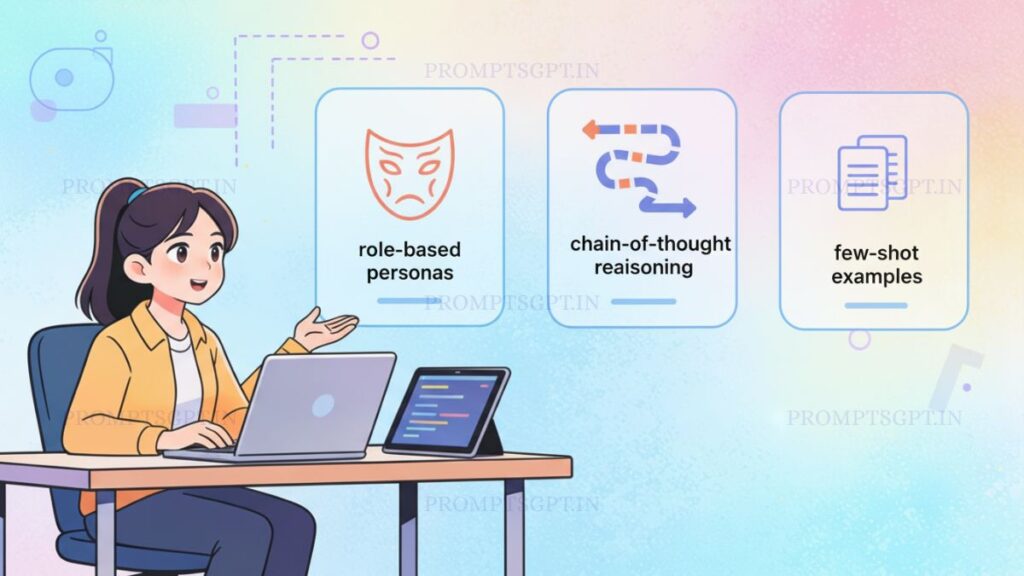
Structured Prompting with Role-Based Personas
Assign a role to the AI and watch your results improve. Instead of asking directly, set the stage.
For example: “Acting as a seasoned copywriter with 15 years in tech marketing, write a LinkedIn post announcing our new AI platform launch.” The AI now understands the perspective it should adopt.
Therefore, personas shape tone, terminology, and overall approach.
Chain-of-Thought Prompting for Complex Tasks
For complex problems, don’t ask for the final answer directly. Instead, ask the AI to reason through the steps.
“Walk me through how you’d approach reducing our company’s customer support response time by 40%. Step by step, explain:
1) What the current problem is,
2) Potential root causes,
3) Three solution options,
4) Pros and cons of each,
5) Your recommended approach.
This method yields more thoughtful, nuanced responses.
Few-Shot Prompting for Consistent Output
Provide 2-3 examples of exactly what you want. Then ask for more of the same.
Show the AI two examples of job descriptions you love, then ask it to write a similar one for your company. The consistency improves dramatically.
Common Mistakes That Undermine Your Prompts
Being Vague About Your Goals
The biggest mistake beginners make is being too general. “Write something creative” won’t work. But “Write a 150-word Instagram caption for a new sustainable fashion line, targeting eco-conscious millennials with an inspirational tone” will.
Forgetting to Provide Context
The AI can’t read your mind. If you need a specific tone, mention it. If your audience is technical specialists, say so. If you have budget constraints, specify them.
Not Iterating When Results Are Subpar
If your first response isn’t perfect, don’t blame the AI. Refine your prompt.
Add more examples. Clarify your expectations. Remove vague terms. Therefore, iteration is how you transform okay results into great ones.

Building Your Reusable Prompt Library
One of Google’s key recommendations is building a library of prompts you’ve crafted and tested.
Create a simple document or spreadsheet where you record:
- The problem you were solving
- The prompt that worked well
- The output quality you achieved
- Variations you tried
Over time, this becomes your personal knowledge base. When you face similar challenges, you already have proven prompts ready.
The Future of Google Prompt Engineering
The field is evolving rapidly. In the next year, expect tools to become even more sophisticated at understanding context.
Prompt engineering is shifting from clever phrasing toward full system design. Winners will own the complete path from intent to governed output.
And AI continues advancing, your ability to guide these tools skillfully becomes more valuable, not less.
Start Your Google Prompt Engineering Journey Today
Google prompt engineering isn’t a distant skill reserved for AI researchers. It’s a practical, learnable ability that delivers immediate, tangible results.
Whether you’re a student aiming to study smarter, a professional seeking career growth, or an entrepreneur scaling your side hustle, mastering prompt engineering gives you a significant edge.
Start with Google’s free Prompting Essentials course. Then practice relentlessly. Test different approaches. Build your prompt library. Iterate until you get results that exceed your expectations.
External Resources for Further Learning
To deepen your Google prompt engineering knowledge, explore these authoritative sources:
- Google Prompting Essentials Course – The official, free course from Google AI experts covering the complete 5-step framework.
- HubSpot’s AI Prompt Writing Guide – Practical, business-focused examples for marketing and sales professionals.

Pingback: Improve Your Google Gemini Prompts in 2026, Earn Money
Pingback: 10 Critical Prompt Engineering Mistakes Killing Your AI Results (How to fix)