Prompt Engineering journey with powerful first prompt in 2026
In 2026, ChatGPT, Gemini, and Claude sit idle on 90% of users’ screens. Prompt engineering isn’t optional anymore—it’s the difference between generic AI slop and pro-level results. Students get better grades. Freelancers win bigger clients.
Introduction: Why Prompt Engineering Matters in 2026
If you’ve ever felt disappointed by an AI’s response, the problem wasn’t the AI—it was your prompt.
Think of prompts like instructions to a skilled chef. If you tell them “make something good,” they might make pizza, biryani, or pasta. But if you say “make a gluten-free paneer tikka pasta with a garlic-herb sauce,” you get exactly what you want.
Prompt engineering is this skill: the art of asking AI the right way to get the right answer. And in 2026, this skill is more valuable than ever.
Whether you’re a student writing assignments, a content creator building your brand, a freelancer earning extra income, or a professional streamlining your work, learning prompt engineering can save you hours every week. More importantly, it can multiply the quality of everything you create with AI.
The best part? It’s not complicated. You don’t need to be a programmer or tech genius. You just need to understand five simple principles.
In this guide, you’ll learn the proven framework that prompt engineers use worldwide—and by the end, you’ll write prompts that get exceptional results on your first try.
What Exactly is a Prompt?
Before we jump into the how, let’s clarify the what.
A prompt is simply the instruction or question you give to an AI model. It’s your input. The AI’s output is its response.
Here are some examples of prompts:
- “Explain photosynthesis like I’m 12 years old”
- “Write a professional email to a client apologizing for a delayed delivery”
- “Create 5 social media captions for a fitness brand’s Instagram post”
- “Debug this Python code and explain what was wrong”
- “Suggest 10 business ideas suitable for tier-2 Indian cities with ₹5 lakh budget”
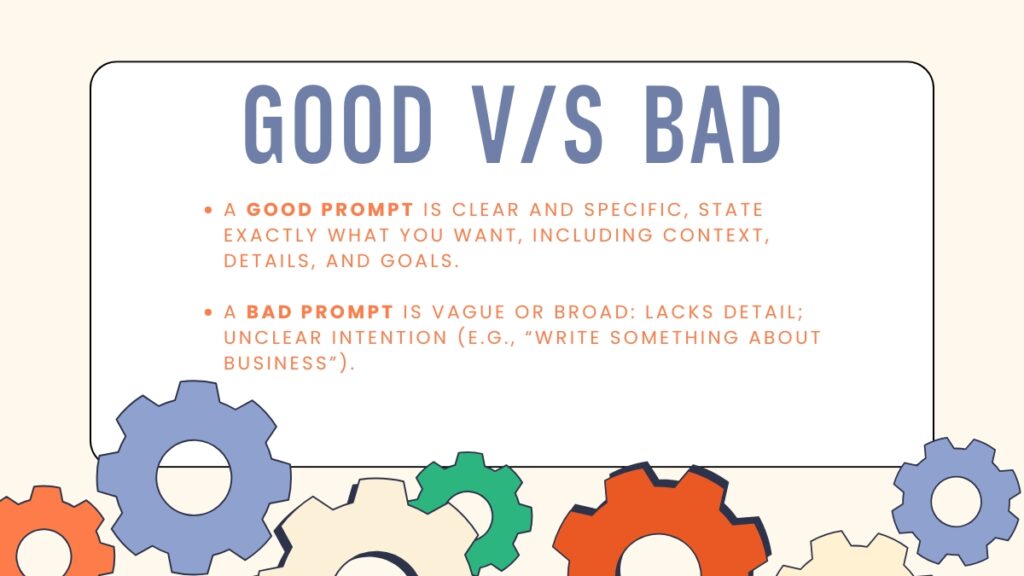
The difference between a good prompt and a bad prompt is like the difference between a clear photograph and a blurry one. Both capture something, but one is infinitely more useful.
The CLEAR Framework: Your Prompt Engineering Blueprint
Prompt engineers across the globe use different frameworks. The most effective one for beginners is called the CLEAR Framework. It has five components:
1. Concise: Say More With Less
Principle: Use clear, direct language. Remove unnecessary words. Be specific, not vague.
Why it matters: AI models process every word you write. Extra words create confusion and waste processing power (called “tokens”), which costs more money if you’re using a paid plan.
Bad Prompt:
“Could you possibly write something about why it’s important to drink water? Maybe include some health benefits? I’d be grateful if you could make it interesting.”
Good Prompt:
“Write a 200-word article explaining 5 health benefits of drinking water daily.”
Notice the difference? The good prompt:
- Removes “could you” and “maybe”
- Specifies the word count (200 words)
- Lists exactly what to include (5 specific benefits)
- Removes emotional fluff (“I’d be grateful”)
2. Logical: Structure Your Thoughts
Principle: Organize your instructions in a clear, step-by-step flow. Think like a teacher giving directions.
Why it matters: When you break complex tasks into steps, the AI doesn’t get confused and produces better results.
Bad Prompt:
“Create a business plan for an online course about prompt engineering. Include the target audience, pricing strategy, marketing plan, and how to handle customer support.”
Good Prompt:
“Create a business plan for an online course about prompt engineering. Follow these steps:
- Define the target audience (who will buy this course?)
- Outline 5 course modules
- Suggest a pricing strategy (₹500 to ₹5,000 range)
- List 5 marketing channels suitable for Indian students
- Explain customer support approach for 1,000+ students”
The good prompt uses numbered steps, making it crystal clear what you want and in what order.
3. Explicit: Be Painfully Clear About Output
Principle: Specify exactly what format and style you want. Don’t assume the AI will guess.
Why it matters: AI models have default behaviors. ChatGPT loves bullet points. Gemini can be verbose. Claude is concise. Without explicit format instructions, you might get something you don’t want.
Bad Prompt:
“Write about the benefits of learning prompt engineering.”
Good Prompt:
“Write a LinkedIn post (150-200 words) about the benefits of learning prompt engineering. Format:
- Hook (2-3 lines that grab attention)
- 3 key benefits as bullet points
- A call-to-action asking readers to learn more
- Use a conversational, professional tone
- Include 1-2 emojis”
Now the AI knows exactly what you want: length, format, tone, and structure.
4. Adaptive: Refine and Improve
Principle: Treat the first response as a draft, not the final answer. Ask follow-up questions to improve it.
Why it matters: The best prompts aren’t always perfect on the first try. The magic is in iteration—making the AI’s response better through follow-ups.
Example:
First Prompt: “Write a blog outline about SEO for beginners.”
First Response: [Generic outline with 5 basic points]
Follow-up Prompt (Adaptive): “This is good, but add Indian examples (like blogs that rank for Hindi keywords). Also, make it specific to blogging in tier-2 Indian cities where internet speeds are slower. Add tips for mobile optimization.”
Improved Response: [Much more targeted, useful outline]
The second response is infinitely better because you adapted your prompt based on feedback.
5. Reflective: Evaluate and Learn
Principle: After you get a response, ask yourself: “Did this actually solve my problem? What could be better?”
Why it matters: Reflection teaches you what works. Over time, you’ll notice patterns in what prompts produce great results.
Questions to Ask:
- Is the response accurate and relevant to what I asked?
- Did the AI misunderstand something?
- Can I use this response directly, or does it need editing?
- What would I change for next time?
- What worked well that I should repeat?
The Step-By-Step Process: Your First Prompt
Now let’s build your very first professional prompt from scratch. We’ll create a prompt for a real scenario: writing a social media caption for a fitness product.
Step 1: Identify Your Goal (Be Specific)
Ask Yourself: What exactly do I want the AI to do?
Too Vague: “Write a caption.”
Specific: “Write an Instagram caption that sells an online fitness course for women over 30 in India.”
Step 2: Add Context (Logical Structure)
Add Details in Order:
- What is the product? (Online fitness course for women 30+)
- Who is the audience? (Indian women, budget-conscious, prefer Hindi/English mix, value health)
- What’s the goal? (Get people to click the link or sign up)
- What tone? (Motivational but relatable, not preachy)
Step 3: Specify the Output Format (Explicit)
Decide:
- Length: 100-150 characters (fits well in Instagram)
- Structure: Start with a hook, add benefits, end with CTA
- Includes hashtags? (Yes, 5 relevant ones)
- Emojis? (Yes, 2-3 relevant ones)
Step 4: Write the Complete Prompt (Concise + Logical + Explicit)
Here’s your first prompt:
“Write an Instagram caption for a fitness course targeting women over 30 in India. Follow this structure:
- Hook: 1 compelling line that speaks to women’s fitness concerns after 30
- Body: 2-3 benefits of the course (energy, confidence, health)
- CTA: Call to action (comment ‘READY’ or click link)
- Add: 5 relevant hashtags
- Tone: Motivational, relatable, Hindi-English mix (Hinglish style)
- Includes: 2-3 relevant emojis
Avoid: Complex fitness jargon. Keep it simple and inspiring.”
Step 5: Test and Refine (Adaptive + Reflective)
After you get the response:
- Read it aloud. Does it sound natural?
- Would it speak to your target audience?
- Is it too long or too short?
- If not perfect, ask a follow-up: “Make this more motivational and add a success story angle.”
Real-World Prompt Examples for Content Creators
Here are practical prompts you can use RIGHT NOW:
Example 1: Blog Post Outline
“Create a detailed blog outline for the article: ‘How to Start a Content Creation Business in India with ₹50,000.’ Include:
- SEO-friendly H2 headings
- 3-5 subheadings per section
- Key statistics about India’s creator economy
- Include local examples (YouTube, Instagram creators from India)
- Tone: Beginner-friendly, practical, encouraging
- Target word count: 2,500 words
- Include 3 sections about monetization (YouTube, Instagram, TikTok alternatives)”
Example 2: Email Sequence
“Write a 3-email welcome sequence for people who sign up for my free ‘Prompt Engineering for Beginners’ course. Email 1 should excite them, Email 2 should provide a quick win (a free prompt template), Email 3 should encourage them to enroll in the paid course. Each email: 100-150 words, conversational tone, include 1 CTA per email. Make it relatable for Indian students (mention college, jobs, career growth).”
Example 3: Sales Copy
“Write a 50-word product description for an online course called ‘AI Prompts Mastery.’ Target audience: Indian professionals wanting to earn ₹50,000-₹1,00,000 monthly as freelance prompt engineers. Emphasize: No coding needed, learn in 30 days, get access to 100+ prompt templates. Tone: Direct, benefit-driven, use power words. Include an emoji.”
Example 4: Social Media Content Calendar
“Create a 2-week Instagram content calendar for a fitness brand targeting women 25-40 in India. Include:
- 10 post ideas with captions (80-120 words each)
- Mix of motivational quotes, tips, success stories, product showcases
- Suggest best posting times for Indian audience
- Include relevant hashtags for each post
- Tone: Empowering, relatable, Hinglish style
Format as a table with: Date, Post Type, Caption, Hashtags, Best Time”
Example 5: Customer Support Response
“Write a professional customer support response to an angry customer who says they didn’t receive their digital course access after 2 days of purchase. The customer is from India and mentions they’re frustrated because they have limited time. Your response should:
- Apologize sincerely
- Take responsibility
- Provide immediate solution (manual access + refund option)
- Build trust
Length: 100-150 words
Tone: Empathetic, professional, solution-focused”
Common Mistakes to Avoid
Mistake 1: Being Too Vague
❌ Bad: “Write something about business.”
✅ Good: “Write a 300-word beginner’s guide about starting an e-commerce business in India with zero investment, targeting college students.”
Mistake 2: Asking Too Many Things at Once
❌ Bad: “Write a blog post, create social media captions, design a thumbnail, and write email copy for my new course.”
✅ Good: “Write 5 Instagram captions (100-150 words each) for my new online course on prompt engineering.”
(Do separate prompts for blog posts, thumbnails, and email copy.)
Mistake 3: Not Giving Enough Context
❌ Bad: “Write a sales email.”
✅ Good: “Write a sales email from a freelance prompt engineer (me) to a small business owner (target) offering to help them automate content creation using AI. The business owner previously showed interest but hasn’t decided yet. Keep it under 200 words, non-pushy, and include a testimonial from another satisfied client.”
Mistake 4: Ignoring Output Format
❌ Bad: “Explain machine learning.”
✅ Good: “Explain machine learning in 5 sentences. Then create a table comparing 3 types of machine learning (supervised, unsupervised, reinforcement) with examples.”
Mistake 5: Not Testing and Refining
❌ Bad: Taking the first response and posting it without checking.
✅ Good: Reading the response, identifying what’s missing, and asking follow-up prompts: “Great, but can you make it more casual and add an example from an Indian startup?”
Pro Tips for Prompt Writing in 2026
Tip 1: Use the “Persona” Technique
Tell the AI to act as someone with expertise. This changes the quality dramatically.
Without Persona: “How do I grow my Instagram?”
With Persona: “You are a social media strategist with 5 years of experience helping Indian creators grow from 0 to 100K followers. Give me a 30-day growth strategy for my fitness Instagram account targeting women 25-40.”
Tip 2: Ask for Examples in Your Prompt
AI creates better content when you show it what you want.
Weak: “Write motivational quotes about fitness.”
Strong: “Write 5 motivational fitness quotes in the style of fitness influencer Rujuta Diwekar—practical, Hindi-influenced, and rooted in Indian fitness culture. Example style: ‘Abs nahi milenge, strength milega. Aur strength se sab kuch mil sakta hai.'”
Tip 3: Use Delimiters for Clarity
When you have multiple pieces of information, separate them clearly.
Task: Write a product description
Product: Online course on AI prompts
Audience: Indian college students
Length: 50 words
Tone: Casual, exciting
Highlight: Learn in 30 days, no coding, earn money as a freelancer
Tip 4: Specify What NOT to Do
Sometimes it’s helpful to tell the AI what to avoid.
Better Prompt: “Write a LinkedIn post about learning AI. Do NOT use: corporate jargon, clichés like ‘blockchain revolution,’ or generic inspirational quotes. DO focus on practical skills and real job opportunities.”
Tip 5: Ask for Revision, Not Recreation
Instead of starting over, ask the AI to improve what it created.
Good Follow-up: “This is great, but it’s 50 words too long. Cut it down and make it punchier. Also, add one statistic about India’s job market.”
The Tools You Can Use Right Now
All the prompts in this guide work with:
- ChatGPT (Free or Plus) – Best for general writing, creative content, versatility
- Google Gemini (Free or Pro) – Best for real-time information, research, Google integration
- Claude (Free or Pro) – Best for long documents, analysis, professional writing
- Grok (Twitter/X) – Best for trends, current events, social media insights
For Indian creators specifically: Start with ChatGPT or Gemini. Both have free versions, and that’s plenty to practice with.
Your First Challenge: Write a Prompt Right Now
Don’t just read this guide—actually do it.
Pick one task:
- Write a social media caption
- Create a blog outline
- Draft an email
- Design a lesson outline
- Write a product description
Now write your first professional prompt using the CLEAR framework:
- Concise: Remove fluff. Be specific.
- Logical: Organize in clear steps.
- Explicit: Specify format, tone, length, output.
- Adaptive: Be ready to refine.
- Reflective: Evaluate the result.
Go ahead. Try it now. Then come back and tell yourself how much better your result was compared to vague prompts.
That’s prompt engineering. And now you can do it.
Conclusion: You’re Now a Prompt Engineer
Here’s what you’ve learned:
- Prompt engineering is a skill anyone can learn in minutes.
- The CLEAR Framework works across all AI platforms (ChatGPT, Gemini, Claude).
- Five principles—Concise, Logical, Explicit, Adaptive, Reflective—unlock exceptional AI responses.
- Real examples matter. Adapt the prompts in this guide to your specific needs.
- Refinement is key. Great prompts aren’t born perfect; they evolve.
The creators, freelancers, business owners, and professionals winning with AI in 2026 aren’t the ones with special access to better AI models. They’re the ones who write better prompts.
Next Steps:
- Bookmark this guide for future reference.
- Practice the 5 principles on your next AI interaction.
- Join the thousands of Indian creators building AI-powered businesses at promptsgpt.in
- Download our free prompt templates (50+ ready-to-use prompts for content creators, business owners, and freelancers).
The best time to learn prompt engineering was yesterday. The second-best time is today.
Start now. Your future self will thank you.
FAQs
Q: Do I need coding experience to learn prompt engineering?
A: Absolutely not. These skills work for anyone—students, content creators, business owners, freelancers. No technical background required.
Q: Which AI tool should beginners use?
A: Start with ChatGPT (free version) or Gemini. Both are user-friendly and have free plans. Practice the principles in this guide, and they’ll work across all platforms.
Q: Can I use these prompts for commercial purposes?
A: Yes! Create content for your business, YouTube channel, blog, social media, courses, freelance projects—everything is fair game.
Q: How long does it take to master prompt engineering?
A: You’ll write decent prompts immediately after reading this. Mastery (writing prompts that consistently produce exceptional results) takes 2-4 weeks of active practice.
Q: Can prompt engineering help me earn money?
A: 100% yes. Freelancers are making ₹50,000-₹3,00,000+ monthly by offering prompt engineering services, content creation using AI, course creation, and AI consulting.
Q: What if my first prompt doesn’t work?
A: That’s completely normal. Use the Adaptive and Reflective principles. Ask a follow-up prompt, refine your instructions, and try again. Most successful prompt engineers refine 2-3 times before getting perfect results.
Last Updated: January 2026 | Reading Time: 12-15 minutes

Leave a Reply